Kingston city council voted to rename Indian Road to Aki Road on Tuesday.
After an 8-5 vote in favour of the renaming, Aki, the Ojibway name for land, was chosen from several options, including Binesi (large bird) and Nookomis (grandmother). Indian Road Park will also be renamed to Odamino Park, which means ‘to play’.
The name change comes after the completed report on the renaming process was read to council yesterday. The City of Kingston began exploring a change to the road in June 2025, when council passed a motion to engage with the residents of the approximately 62 addresses on the road, Indigenous organizations, and multiple Indigenous Nations in the region.
According to the city of Kingston, the Indigenous community in Kingston was also invited to participate in a series of talking circles regarding the change. According to the report, participants in the three talking circles felt the use of the word “Indian” should be discontinued in favour of a “culturally appropriate” name.
“…Regardless of individual thoughts on the word Indian within the circle, there are many who experience pain with its continued use, and for that reason the renaming should move forward,” said the report.
The city of Kingston report survey shows 46 residents were polled following a resident meeting in March, who responded to the shortlist of names by completing the survey or emailing feedback. Approximately 60 per cent of respondents selected ‘none of the above’, while ‘Aki’ was the most popular name choice.
Comments on the survey were generally negative, with some residents expressing frustration at the change process, and most opposed the change altogether.
“I don’t feel any of the names are acceptable. Indian Road is not derogatory and was chosen as a tribute to this community. The process that has been used for this name change is also unacceptable,” wrote one resident in their survey comments.
Other comments supported the change.
“I am so happy that this is finally happening. Many of the residents on this street are very unhappy with a street name that is perceived as an outdated and derogatory colonial reference to the Indigenous people of Canada. This is one of many steps we all must take towards true reconciliation,” wrote another resident.
According to Coun. Jeff McLaren, who conducted his own door-to-door survey of 74 residents in 44 households on the road, nearly 80 percent of households were against the renaming. This is the latest of three surveys exploring a name change of the road in nine years. The 2017 and 2021 surveys also showed the majority of residents opposed a name change at the time.
“This was never about whether to honour Indigenous peoples. Everyone at that table wanted to do right by reconciliation, and so do I,” said McLaren in a press release ahead of the June 16 report presentation to council. “It is about whether a serious decision was made on sound evidence and a fair process. It was not. A decision this consequential deserves a real count of the whole street — which is what residents now have, for the first time.”
In a statement to YGK News, Coun. Gregory Ridge said, “I empathize with the residents of Indian Road and hear their concerns and frustrations, which were clearly expressed through the City’s consultation process,” said Ridge.
“Council also has a responsibility to consider the broader context of why renaming the road has been proposed. The name ‘Indian Road’ is in violation of Kingston’s Street Names Bylaw as it is widely viewed as derogatory and harmful to Indigenous people,” Ridge continued.
Council and community members were able to witness multiple presentations from advocates sharing their perspective on the name change.
Dennis Mahoney, who has a strong connection to Indian Road, gave a delegation that outlined nine years of research representing the residents of Indian Road who oppose the change.
“Indian Road is where I was raised, my mother has lived there for 62 years. It’s part of her life, it’s part of her legacy, I feel like it’s being erased,” said Mahoney.
Mahoney felt as though, during past council meetings, thorough research was not supplied or conducted on the matter.
“I’m here tonight to put the complete information on the record,” said Mahoney.
Daniel Shipp, a resident in support of the name change, communicated with council numerous times on the issue in the past year. He felt that even through lengthy communication, the council’s process toward changing the street was respectful towards the Indigenous community.
“Nothing about us without us as a fundamental guiding principle…It is of primary importance that the First Nations of our region be consulted and continue to be recognized and honoured appropriately,” said Daniel Shipp
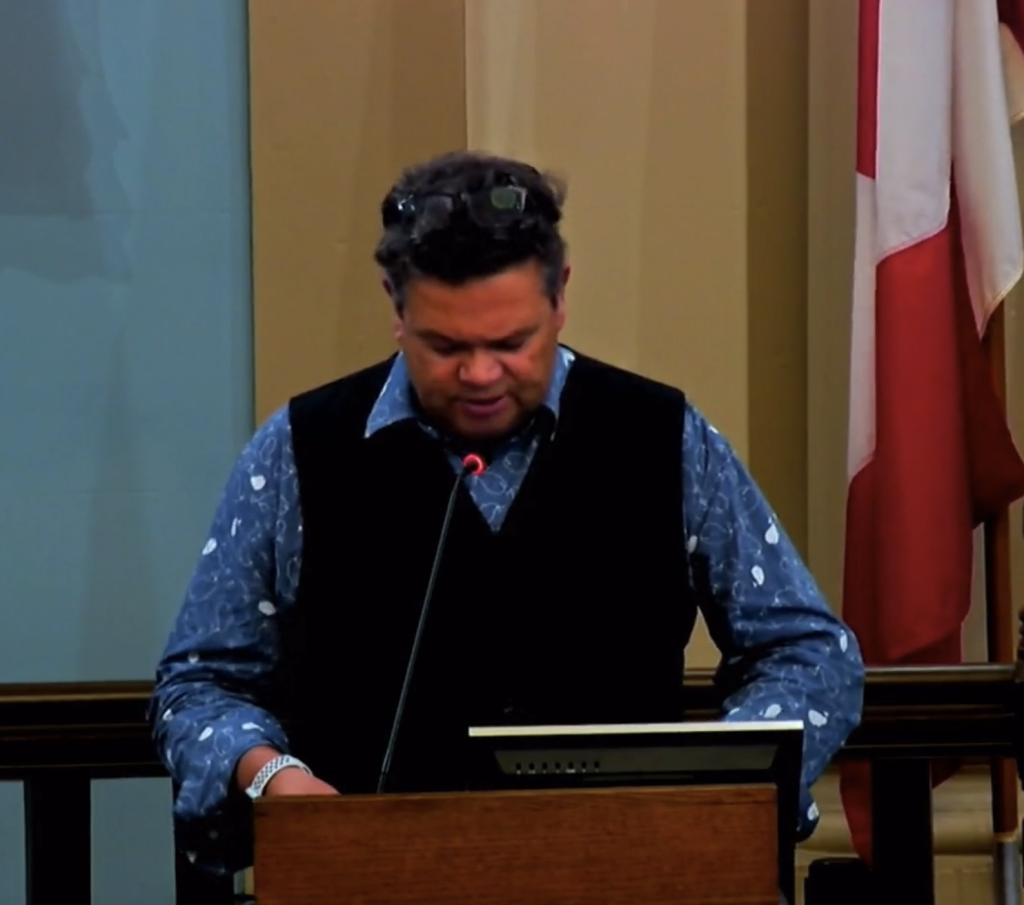
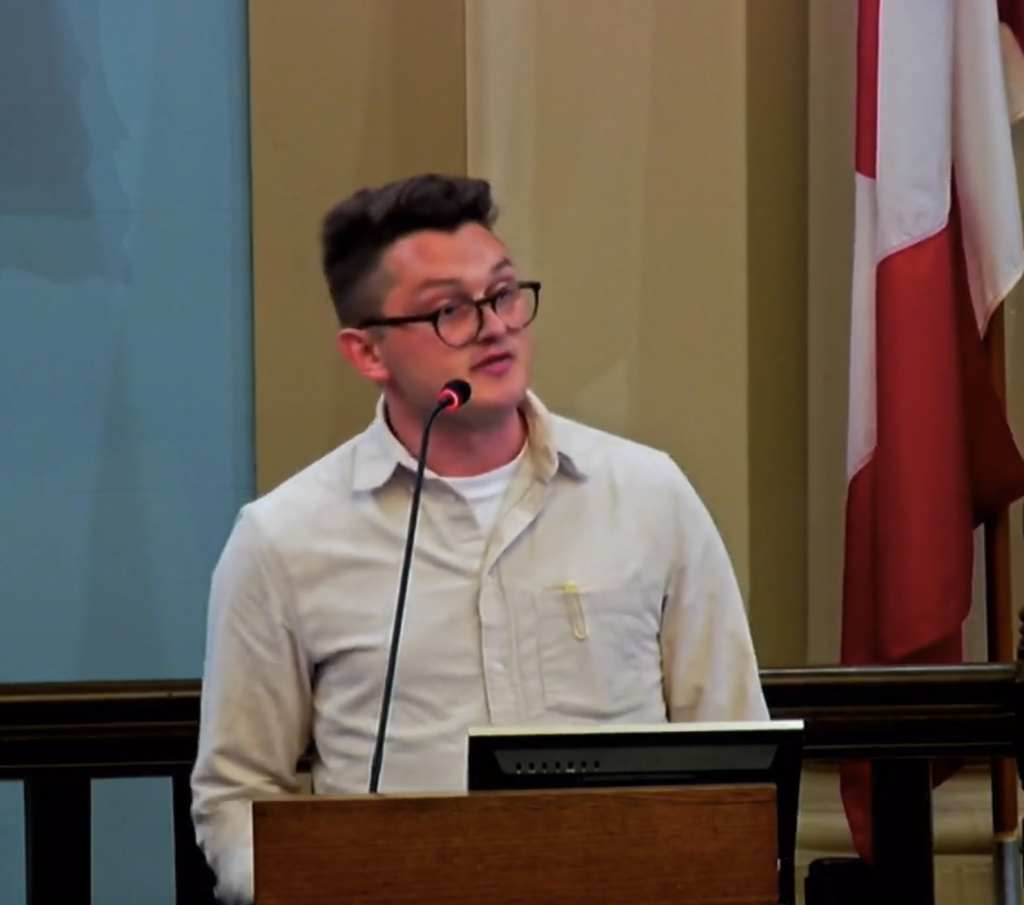
Daniel Shipp and Brandon Maracle speaking to council during the delegation period (Kingston City Council Meeting Video)
Shipp commended council for their work with Indigenous leaders and for reaching out to the community to hear their suggestions
“To me, that is the genuine sound of ‘with us’, action, listening,” said Shipp.
Many discussions during the delegation period surrounded the harmful nature of the word Indian and debated whether or not it’s derogatory.
Brandon Maracle, executive director of Kingston Native Centre and Language Nest, spoke to council to explain his thoughts on the word Indian.
“I won’t take the liberties of sharing every community member’s story in relation to the term Indian, but I ask you to trust me to say that I’m not alone in this, finding this term both harmful and derogatory,” said Maracle.
Maracle explained that although changing the street name won’t change the past, it will, however, continue to serve as a reminder to the Indigenous community of the history of the word and its insulting nature.
“Council has the opportunity this evening to choose language that better reflects the community that I know and that I believe that Kingston wants to be,” said Maracle.
Council approved a budget of $46,250 for the renaming project in the report, alongside payments of $250 for each affected household, assistance with changing provincial identification and passports, mail forwarding for a year, and a plaque recognizing the history of the area in Strathcona Park.